
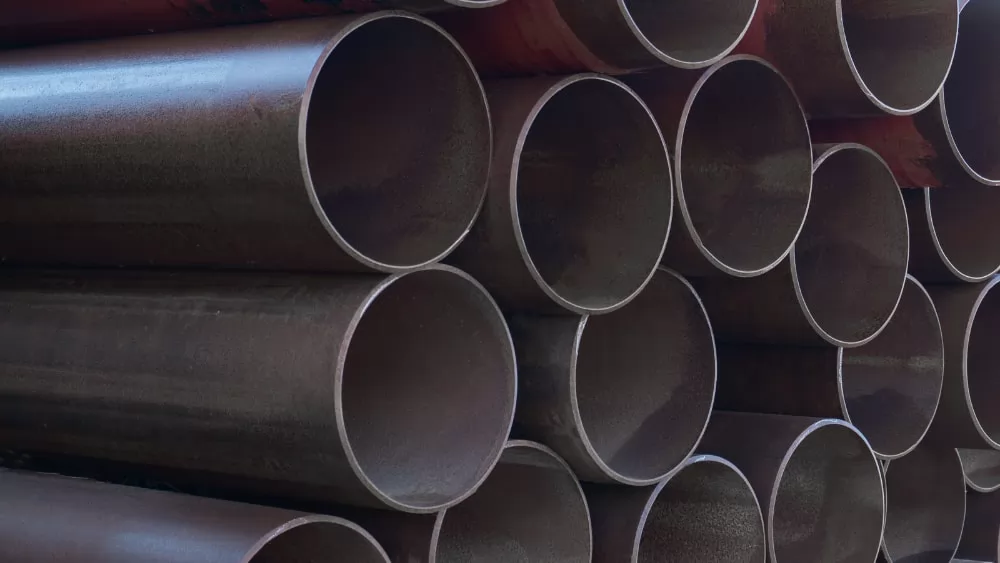
Seamless steel pipes are an essential component in many industries, from oil and gas to construction and mechanical engineering. If you’re a buyer, engineer, or project manager looking to understand what seamless steel pipes are, how they are made, and why they are widely used, this guide will walk you through everything you need to know. We’ll cover their definition, manufacturing process, main types, advantages, and typical applications, helping you make informed decisions for your projects.
According to the description on Wikipedia, a seamless steel pipe (Also called SMLS Steel Pipe) is a type of tube that has no welding seam. A seamless pipe is produced from solid steel in sheet or bar form, which is first formed into a solid round shape known as a “billet.” The billet is then heated and cast over a piercing rod to create a hollow shell, ultimately forming a seamless tube. Because this manufacturing method eliminates weld joints, seamless pipes offer higher strength, better uniformity, and superior pressure resistance. A seamless tube may also be referred to as a seamless pipe. (what is seamless pipe wikipedia)
One of the standout features of seamless pipe is its excellent corrosion resistance. Unlike ordinary steel, seamless steel pipe maintains long-term stability in environments where moisture, chemicals, or temperature fluctuations are present. Its ability to resist general corrosion helps extend service life and reduce maintenance costs. Additionally, the inner surface is clean, free of toxins, and safe for applications involving water, food processing, or other sensitive materials.
Seamless steel pipes also exhibit superior mechanical properties. They deliver exceptional strength, toughness, and impact resistance even under extreme temperatures—whether high or low. Because the pipe contains no welded joint, it is less likely to crack, deform, or fail during operation. This makes seamless pipe an ideal choice for high-pressure boilers, hydraulic systems, petroleum casing, and structural support.
Seamless steel pipes, despite their high strength and excellent pressure resistance, also have several drawbacks that buyers should consider. Their production process is more complex and costly, making them more expensive than welded pipes. Seamless pipes also face limitations in large diameters, often resulting in a narrower size range. Because they are hot-rolled, they tend to have greater tolerance variations and less dimensional accuracy.
Quality control is more challenging, as any defects must be detected throughout the entire pipe body, requiring more advanced inspections. Production usually involves higher MOQs and longer lead times, and seamless pipes are generally less suitable for ultra-thin wall applications.
| Application | Description |
|---|---|
| Oil & Gas Transmission Pipelines | Used for transporting crude oil, natural gas and refined products due to high pressure resistance and durability. |
| High-Pressure Boiler Tubes | Designed for boilers and superheaters where pipes must withstand high temperature and pressure. |
| Heat Exchanger Tubes | Employed in heat exchangers for efficient thermal transfer in power plants, petrochemical, and HVAC systems. |
| Hydraulic & Mechanical Components | Used in hydraulic cylinders, piston rods, and mechanical assemblies requiring high strength and fatigue resistance. |
| Automotive Parts | Applied in suspension systems, drive shafts, and other structural automotive components needing precision and toughness. |
| Structural Tubing for Construction & Machinery | Used as load-bearing structural elements in buildings, bridges, cranes, and heavy machinery frames. |
| Petrochemical Processing | Suitable for reactors, process lines and piping that handle corrosive media and high-pressure conditions. |
| Power Generation Systems | Used in thermal, nuclear, and renewable power plants for steam lines, condensers, and pressure vessels. |
| Drilling Operations | Applied in drill collars, casing and tubing for oil & gas wells, where high mechanical strength is required. |
Seamless pipes can be categorized by material into carbon steel pipes and stainless steel pipes. Based on different applications, they are commonly classified as boiler tubes, mechanical tubes, and seamless casing pipes.
| Feature | Seamless Steel Pipe | Welded Steel Pipe |
|---|---|---|
| Manufacturing | Made from solid steel billets, pierced and rolled into a hollow pipe without any welds. | Made by rolling and welding steel plates or strips along a seam. |
| Strength | Higher strength and pressure resistance due to the absence of welds. | Lower strength at the welded seam compared to seamless pipes. |
| Diameter & Wall Thickness | Limited by billet size; usually smaller diameters and thicker walls. | Can produce larger diameters and thinner walls easily. |
| Cost | More expensive due to complex manufacturing process. | Generally cheaper and faster to produce. |
| Dimensional Accuracy | Good but may have slight variations due to hot rolling. | Generally more uniform in wall thickness for standard sizes. |
| Applications | High-pressure pipelines, boilers, mechanical and hydraulic systems. | Water pipelines, low-pressure applications, structural tubes. |
In summary, seamless steel pipes are high-strength, durable, and reliable tubes manufactured without any welded seams, making them ideal for demanding applications such as oil and gas pipelines, boilers, mechanical components, and structural projects. Their uniform structure, excellent pressure resistance, and corrosion performance ensure long service life and safety. Whether for industrial, engineering, or high-precision applications, seamless steel pipes remain a preferred choice for engineers and buyers seeking quality and dependability.
For competitively priced, high-quality seamless steel pipes, contact us today—our team can provide expert guidance, customized solutions, and timely delivery to meet your project needs.


Your Name*
Your Email*


